HCE210 NTP Clock Server
Six Gigabit ports, with defined redundancy options.
The HCE210 platform provides ETH0–ETH5 Gigabit connections, network bonding and support for a paired-server standby arrangement. Select the internal clock and power configuration alongside the required timing modules.
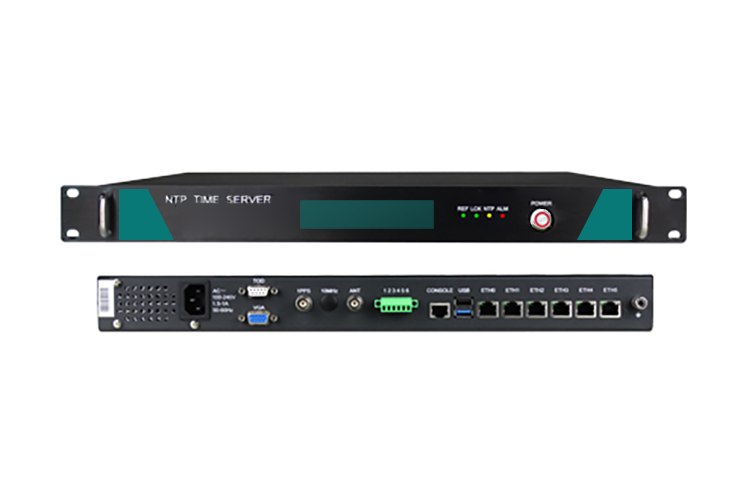
Specify resilience at the right level.
Specify what must remain available when a connection, reference or unit is interrupted. HCE210 offers different features for each requirement; selecting one does not automatically provide the others.
Network-port continuity
Bonding supports failover and load balancing among ports on one HCE210. Establish the required port grouping with the network owner before specifying the operating configuration.
Reference continuity
Reference sources can switch by priority. Optional OCXO or rubidium hardware adds dedicated holdover capability; the clock table records the distinct frequency and holdover figures.
Power and unit continuity
The D option adds redundant power supplies. A standby partner is a second HCE210 using heartbeat detection and a shared virtual IP address. Include the required number of units in the equipment schedule.
Choose your configuration.
These three HCE210 builds distinguish the base satellite receiver from configurations with dedicated clock and redundant-power options. Confirm the 1U or 2U enclosure for the selected combination.
HCE210-GN
Six-port HCE210 platform with combined GPS/BeiDou reception.
Discuss this configuration →HCE210-GN-O-D
OCXO-equipped HCE210 with GPS/BeiDou reception and redundant power supplies for short interruptions of the antenna reference.
Discuss this configuration →HCE210-GN-R-D
Rubidium-equipped HCE210 with GPS/BeiDou reception and dual power supplies. Intended for longer reference interruptions; confirm the holdover conditions and enclosure required.
Discuss this configuration →Ordering codes & option selection
Read the HCE210 code groups as separate hardware choices. Clock, power and output selections must be checked together because enclosure and module compatibility can restrict a combination.
Reference source
| Code | Reference |
|---|---|
| GP | GPS |
| BD | BeiDou |
| GN | BeiDou + GPS |
| BD3 | BeiDou-3 |
| CDMA | CDMA |
| PTP | PTP / IEEE 1588v2 |
| TOD | 1PPS + TOD |
| BDC | IRIG-B input at RS422 level |
| N | No reference source by default |
Holdover clock
| Code | Clock |
|---|---|
| O | Crystal oscillator (the specified option is an OCXO) |
| R | Rubidium atomic clock |
| C | External caesium clock |
| N | No dedicated holdover clock unit by default |
Power
| Code | Power option |
|---|---|
| Default | 220 V single power supply |
| D | Redundant 220 V power supplies |
| P | Lithium battery |
| DC | DC input |
Output / interface options
| Code | Option |
|---|---|
| PTP | PTP / IEEE 1588v2 |
| BDC | IRIG-B DC output |
| BAC | IRIG-B AC output |
| SQ | 10 MHz square-wave output |
| SIN | 10 MHz sine-wave output |
| ALM | Dry-contact alarm |
A source footnote marks some options as available only for 2U equipment; the affected markers are not clear in the supplied image. Confirm enclosure compatibility before ordering.
All listed model examples
| Model | Description |
|---|---|
| HCE210-GN | BeiDou/GPS — common model |
| HCE210-GN-O | BeiDou/GPS with OCXO — common model |
| HCE210-GN-R-D | BeiDou/GPS with rubidium clock and dual power supplies — common model |
| HCE210-GP | GPS only |
| HCE210-BD | BeiDou only |
| HCE210-GN-O-D | BeiDou/GPS with OCXO and dual power supplies |
| HCE210-GN-R-D-PTP | BeiDou/GPS with rubidium clock, dual power supplies and PTP |
| HCE210-CDMA | CDMA |
| HCE210-GNCDMA-R-D | BeiDou/GPS/CDMA with rubidium clock and dual power supplies |
| HCE210-GN-O-D-BDC | BeiDou/GPS with OCXO, dual power supplies and IRIG-B output |
| HCE210-N-O | Stratum 2 time server with OCXO |
| HCE210-BDC-O | IRIG-B input with OCXO |
Use these HCE210 references when discussing a build. A final quotation should identify the complete suffix string, enclosure height and supply arrangement.
Specifications & interfaces.
Expand the HCE210 data groups to examine the six-port platform, clock alternatives and management functions. Optional PTP performance is separate from the standard NTP service.
01 Network protocols & timing performance
| Parameter | Specification |
|---|---|
| Time protocols | NTP v1/v2/v3/v4 (unicast, multicast, broadcast and Autokey); SNTP |
| Remote access / transfer | Telnet, SSH, FTP |
| Network management | SNMP v1/v2/v2c/v3; MIB II (RFC 1213) |
| IP support | IPv4, IPv6, IPv4/IPv6 hybrid mode |
| Parameter | Specification |
|---|---|
| Satellite-referenced synchronisation accuracy | <100 ns |
| NTP network synchronisation accuracy | 0.1–2 ms, typical on a local area network |
| Client capacity | >1,344,000 |
| NTP request capacity | ≥14,000 requests/s |
NTP accuracy, hardware synchronisation and 1PPS accuracy describe different measurements. Client capacity depends on the polling interval and test load; the supplied sheets do not define those conditions.
Additional performance figures in the source datasheet
| Parameter | Specification |
|---|---|
| Hardware synchronisation accuracy | <30 ns, typical RMS, using a BeiDou/GPS receiver |
| LAN NTP time-service accuracy | <0.1 ms, using a BeiDou/GPS receiver |
| NTP accuracy on complex networks | <10 ms |
| NTP requests per port | ≥14,000 requests/s |
| Time-synchronisation clients | >1,000,000 |
| Daily average frequency accuracy | <1 × 10⁻¹² |
| MTBF | >100,000 h |
The feature summary quotes LAN NTP accuracy <0.1 ms, while the detailed table quotes 0.1–2 ms typical. It also quotes hardware synchronisation <30 ns typical RMS, separately from satellite-referenced synchronisation <100 ns. Confirm measurement points and conditions for the ordered configuration.
02 Satellite receivers
| Receiver | Signal band | Channels | Cold start | Hot start | Reacquisition | Timing accuracy | Position accuracy |
|---|---|---|---|---|---|---|---|
| GPS receiver | L1 | 32 | 35 s | 1 s | 1 s | 30 ns | 2 m |
| BeiDou receiver | B1I | 32 | 35 s | 1 s | 1 s | 30 ns | 2 m |
| BeiDou/GPS receiver | L1, B1I | 32 | 35 s | 1 s | 1 s | 30 ns | 2 m |
| BeiDou-3/GPS receiver | L1, B1I, B1C | 40 | 35 s | 1 s | 1 s | 30 ns | 2 m |
The timing-grade BeiDou/GPS receiver supports BeiDou-only, GPS-only and combined BeiDou/GPS positioning modes.
03 Optional clock & holdover specifications
| Clock parameter | OCXO | Rubidium atomic clock |
|---|---|---|
| Average frequency accuracy | <1 × 10⁻¹² / 24 h | <1 × 10⁻¹² / 24 h |
| Frequency stability | <5 × 10⁻¹² / s | <2 × 10⁻¹¹ / s |
| Daily ageing rate | <5 × 10⁻¹⁰ | <5 × 10⁻¹² |
| Phase noise | ≤−155 dBc/Hz at 10 kHz | ≤−155 dBc/Hz at 10 kHz |
| Holdover accuracy | <1 ms / 72 h | <3 ms / year |
Clock figures are quoted from the supplied datasheet. Confirm the clock option, warm-up, reference-lock history, temperature and measurement conditions for the project.
04 Timing signals & optional modules
Standard 1PPS and serial outputs
| Parameter | Specification |
|---|---|
| 1PPS accuracy | Offset from standard UTC <30 ns RMS |
| 1PPS electrical characteristics | TTL level; rising edge; pulse width 100 ms |
| TOD serial output | RS232 level; 9600 baud; 8-N-1 |
Optional external reference inputs
| Parameter | Specification |
|---|---|
| 1PPS + TOD input | TOD complies with NMEA 0183. |
| IRIG-B input | RS422 level; complies with GJB 2991A-2008. |
| Mobile-network receiver | Supports CDMA/4G communication networks. |
| PTP input | Complies with IEEE 1588v2. |
Optional time and frequency outputs
| Parameter | Specification |
|---|---|
| IRIG-B output module | Complies with GJB 2991A-2008; DC output at TTL/RS422 levels; AC output, balanced or unbalanced, with a modulation amplitude ratio of 3:1. |
| PTP output module | Complies with IEEE 1588v2; supports Gigabit Ethernet / SFP+ optical ports, unicast/multicast, one-step/two-step modes and AI/SI/DI settings; up to 256 clients per PTP port. |
| 10 MHz square-wave output | LVTTL level; accuracy and stability follow the internal clock signal. |
| 10 MHz sine-wave output | 50 Ω impedance; output power >7 dBm; accuracy, stability and phase noise follow the internal clock signal. |
Other modules / interfaces
| Parameter | Specification |
|---|---|
| DCIN | 12 V DC input for connecting an external battery or another DC power source. |
| VGA | Complies with the general VGA display standard; connects directly to an external monitor. |
| Dry-contact alarm | Terminal-block interface; supports loss-of-lock and fault alarms. |
AI/SI/DI abbreviations are reproduced as supplied; the datasheet does not define them. SFP+ is listed for the optional PTP module and does not change the standard NTP port specification. Confirm the available option combination.
05 Physical & environmental specifications
| Parameter | Specification |
|---|---|
| Dimensions — 1U | 433 × 44.5 × 365 mm |
| Dimensions — 2U | 433 × 89 × 405 mm |
| Weight | <5 kg (1U); <7 kg (2U) |
| Power input | 100–240 V AC; redundant 100–240 V AC option* |
| Operating temperature — main unit | −10 °C to +55 °C |
| Operating temperature — antenna | −40 °C to +75 °C |
| Storage temperature | −45 °C to +85 °C |
| Humidity | 95%, non-condensing |
| Power consumption | 25 W (crystal oscillator); 40 W (rubidium clock) |
Dimensions, power and interfaces must be confirmed for the selected variant. The supplied footnote indicates that some marked options are 2U-only, but its option markers are unclear.
06 Front & rear panels
- High-brightness VFD display shows the current time, reference lock status, satellite count, latitude/longitude, altitude, IP address of each network interface and system operating status.
- Three-colour indicators show satellite lock, internal clock lock, NTP service communications and equipment alarms.
| Interface | Description |
|---|---|
| ANT | 1 × BNC satellite antenna connector; 5 V feed |
| ETH0–ETH5 | 6 × RJ45; 10/100/1000 Mbps auto-negotiating Ethernet |
| CONSOLE | 1 × RJ45; RS232-level control terminal |
| TOD | 1 × DB9 female; RS232 level; time and position information |
| 1PPS | 1 × BNC; TTL level |
| General-purpose interfaces | Standard USB and VGA; the summary specifies 2 USB ports and 1 VGA port. |
| Options | External reference inputs, PTP, 10 MHz, IRIG-B, dry-contact alarms and battery options; contact sales for details. |
07 Functions, management & software
Functions
- Operates as a Stratum 1 network time server by default; can also be configured as a Stratum 2 server.
- Supports MD5-based authentication.
- Supports multiple reference sources with automatic switching according to configured priorities.
- Supports network bonding for port failover and load balancing within a single server.
- Supports heartbeat detection and a shared virtual IP address for two-server hot standby.
- Web interface supports remote access, management, configuration and maintenance.
- NTSM monitoring software provides detailed monitoring of NTP servers and clients.
- Provides an SNMP service interface for integration into network management systems.
- Supports dry-contact alarms, subject to the selected hardware option.
- A range of options supports different application requirements.
- Supports event logging and remote access via SSH, Telnet and CONSOLE.
Web management
- Convenient, ready-to-use interface for overall equipment monitoring.
- Displays operating status, including NTP, BeiDou/GPS and network status.
- Supports SNMP configuration (including trap destinations), network settings and NTP settings.
- Allows currently running server services to be enabled or disabled.
- Supports downloading configuration files and MIB definition files.
NTSM monitoring software
- Provides detailed monitoring of the NTP service on HCE210 devices.
- Monitors server status, including synchronisation state, time offset and stratum information.
- Monitors BeiDou/GPS reference information, including lock and positioning status.
- Monitors NTP client access and time offsets.
- Supports time-offset threshold alarms, loss-of-lock alarms and state-change alarms.
- Supports alarms via SNMP, syslog and email.
- Supports service-quality monitoring of server clusters and preferred-server selection/control operations.
SNTP synchronisation software
- Windows-compatible software synchronises the system clock using SNTP.
- Supports automatic startup and operation in the system tray.
- A configurable synchronisation interval enables automatic synchronisation.
- Manual time synchronisation is also supported.
The supplied summary lists synchronisation with Windows, Linux, UNIX, Sun Solaris and IBM AIX systems. Confirm current operating-system and software-version requirements.
The source also lists embedded Linux, remote wake-up, scheduled startup/shutdown, client synchronisation-status statistics and server-cluster selection/control functions.
The overview also lists certificate-based mechanisms, without specifying their implementation. Protocol support is not a claim of security certification.
08 Package contents & optional accessories
| Included item | Quantity / details |
|---|---|
| Main unit | 1 |
| High-sensitivity timing antenna with 30 m cable | 1 |
| Mounting bracket set | 1 set |
| 1 m power cable | 1 |
| 1.5 m control cable | 1 |
| Chinese-language user manual | 1 |
| Documentation disc | 1 — documentation, SNTP time-synchronisation software, NTSM monitoring software and equipment operating instructions |
Optional accessories
- Antenna feeder lightning arrester
- Special cable lengths: 50 m, 80 m or 100 m
- Portable handheld calibration unit
- Ethernet digital slave clock
Package contents are as listed in the supplied datasheet. Confirm manuals, media, antenna cable and power-cord quantities for the ordered configuration.
Is the six-port platform required?
A smaller project may call for the single-port HCE208 or its desktop variant. Review the range matrix before committing to the HCE210 platform and its additional hardware options.
Separate the hardware decisions.
Do six Ethernet ports provide two-server redundancy?
ETH0–ETH5 are connections on one appliance. Bonding addresses port availability within that unit. Paired-server standby is a different arrangement using two HCE210 units, heartbeat detection and a shared virtual IP address.
What does D identify in HCE210-GN-O-D?
D is the redundant-power option. In this example, GN identifies GPS/BeiDou and O selects the OCXO. Confirm the permitted chassis configuration and input supply for the complete model.
How do the O and R clock choices differ?
O denotes an OCXO; R denotes a rubidium atomic clock. Their frequency stability, ageing, holdover and power-consumption figures differ in the specification tables. Select against the required reference-interruption conditions.
How many clients can an optional PTP port support?
The PTP module specification lists up to 256 clients per PTP port. That limit concerns the optional PTP interface and should not be substituted for the NTP client-capacity or request-rate figures.
What needs checking before a 1U or 2U order?
Request the configured rear-panel drawing and confirm the clock, power and expansion modules together. The source documentation restricts some marked options to 2U; the applicable combination needs to be identified for the order.
Specify your HCE210 package.
Describe the required HCE210 clock, power and interface combination. If the specification includes paired standby, identify both units and the intended operating arrangement.
- Total units, including any standby partner
- OCXO or rubidium selection and reference inputs
- Bonding, optional PTP and other module requirements
- Enclosure height, power configuration and destination
Please include HCE210 in your project message.
Attach the equipment schedule if available, showing which options belong to each HCE210 unit.